Global Health & Medicine 2026;8(4):316-321.
Practical application of indocyanine green fluorescence imaging in left hepatopancreatoduodenectomy for cholangiocarcinoma with right-sided ligamentum teres
Yasuda T, Watanabe G, Sugimoto A, Tanaka R, Tauchi J, Nishimura S, Kinoshita M, Nishio K, Shinkawa H, Ishizawa T
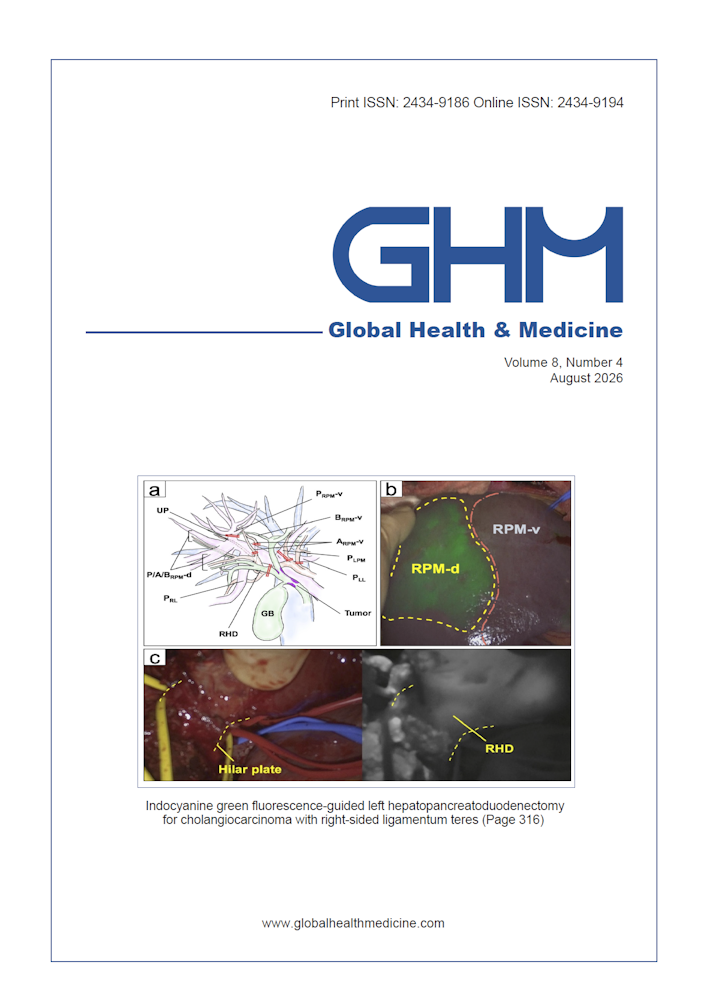
We report the surgical techniques and outcomes of hepatopancreatoduodenectomy (HPD) using indocyanine green fluorescence imaging (ICG-FI) for Bismuth type IIIb perihilar cholangiocarcinoma in a patient with right-sided ligamentum teres. ICG-FI was used in three ways: i) positive staining to delineate the liver transection line, ii) confirmation of vascular perfusion, and iii) visualization of the bile duct. Because the bile duct of the ventral region of the right paramedian sector (RPM) drained into the left hepatic duct, an extended left hepatectomy including resection of the ventral region of the RPM was planned. Although the anatomical anomaly made it difficult to identify the liver transection line between the ventral and dorsal regions of the RPM using landmarks such as the hepatic veins and the falciform ligament, positive staining of the dorsal region of the RPM enabled accurate delineation of the transection line. As there was suspected tumor invasion into the right side of the main portal vein, wedge resection and reconstruction with short-axis suturing were performed. Subsequently, fluorescence was observed to pass through both the right hepatic artery and the reconstructed portal vein uninterruptedly, indicating continuous blood flow. ICG-FI also facilitated identification of the right hepatic duct. It was divided at the root, and the resection margin was confirmed to be negative by intraoperative frozen-section examination. HPD was successfully completed, achieving R0 resection with an operative time of 789 minutes and blood loss of 650 mL. The patient developed a pancreatic fistula, which resolved with drain management and antibiotic therapy, and was discharged on postoperative day 36. Integrated use of ICG-FI provided useful adjunctive guidance in this technically challenging case.
DOI: 10.35772/ghm.2026.01057
Full Text: